
Breaking Free from the
Shadow Side of Your Leadership
The uncomfortable truth
Every leader faces a shadow side of leadership.
Not a disorder. Not a defect.
But a set of predictable tendencies that show up—especially under pressure.
Leadership doesn’t create these tendencies.
Leadership reveals them.
And the greater the influence, responsibility, and stress…
the more exposed our shadow becomes.
Why the Shadow Side of Leadership Matters
Most leadership failures don’t begin with bad intentions.
They begin with unexamined patterns.
Under pressure—fatigue, fear, even success—leaders default to behaviors that once helped them succeed…
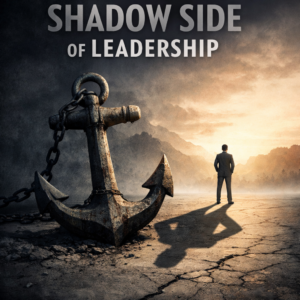
but now quietly act like anchors, reflecting the shadow side of leadership.
As Gary McIntosh and Samuel Rima write in Overcoming the Dark Side of Leadership:
What once protected us… can eventually control us.
Five common shadow tendencies
(Not diagnoses—but patterns we drift toward under pressure)
🟠 Compulsive
Control-oriented, driven, highly responsible
→ Shadow drift: perfectionism, micromanaging, overwork
→ Impact: others feel controlled, never quite “enough”
🟢 Co-dependent
Caring, relational, team-first
→ Shadow drift: rescuing, avoiding conflict, needing approval
→ Impact: unclear expectations, weak accountability
🔵 Narcissistic
Confident, visionary, results-focused
→ Shadow drift: image management, self-focus, lack of empathy
→ Impact: people feel used, unseen, or secondary
🟣 Passive-Aggressive
Thoughtful, cautious, conflict-aware
→ Shadow drift: indirect resistance, procrastination, quiet disengagement
→ Impact: confusion, lack of clarity, slow erosion of trust
🔴 Paranoid
Alert, discerning, protective
→ Shadow drift: suspicion, defensiveness, isolation
→ Impact: low trust, guarded culture, relational distance
Under stress, leaders don’t become someone new.
They become more fully who they already are.
Here’s a link to the book Overcoming the Dark Side of Leadership
Here’s the danger
When shadow tendencies go unnamed, they gain power.
They become anchors we don’t realize we’re dragging:
-
We justify behavior
-
We rationalize decisions
-
We silence internal warning signs
All while performance may still look strong…
even as our leadership is being quietly weighed down.
A biblical contrast
Scripture consistently ties leadership to self-awareness and humility.
Consider Saul vs. David:
-
Saul remained blind to his self-focused behavior—even when confronted
-
David stayed teachable, responsive, and open to correction
David prayed:
“Search me, O God, and know my heart… see if there is any offensive way in me.”
—Psalm 139:23–24
David wasn’t perfect.
But he refused to let his shadow stay hidden.
So what helps leaders stay healthy?
-
🔦 Name your shadow
Awareness loosens the chain -
🪞 Invite honest mirrors
Others help you see what you can’t -
🧭 Slow down under pressure
The shadow thrives in hurry and isolation
Your shadow and trust
We’ve talked before about Lencioni’s model of cohesive teams.
At the foundation is vulnerability-based trust—the willingness to admit mistakes, ask for help, and acknowledge limits.
Here’s what many leaders miss:
👉 Unacknowledged shadow erodes trust
👉 Owned shadow builds it
I’ve seen this repeatedly:
When leaders name their shadow—and admit how it shows up under stress—
they begin to break the anchor free.
And when they normalize that everyone has a shadow…
they create safe, high-trust environments where people can grow.
Bottom line
Your shadow side of leadership will either be faced…
or it will eventually be felt by others.
You will either carry the weight of it consciously…
or your team will carry it relationally.
Teams don’t suffer most from leaders who lack talent.
They suffer from leaders who are unknowingly dragging anchors.
Call to action
If you’re serious about growing as a leader:
Don’t just invest in skills.
Invest in the courage to know yourself.
Because the goal isn’t perfection—
👉 It’s freedom.
Let’s have a conversation about how to identify your shadow side and see it transformed.